"Artificial Intelligence without Big Data Analytics is lame, and Big Data Analytics without Artificial Intelligence is blind." Dr. O. Aly, Computer Science.
The purpose of this discussion is to
write a research position on some of the most significant challenges facing
information technology (IT) today. The
focus is on the top 5 issues that are considered the most important from the
researcher’s point of view. These
challenges can be a strategy, budget,
pace, scope, architectures, mergers or acquisitions, technologies, devices,
skills, and chief information officer
(CIO) role.
Challenges Facing Information Technology Department
Various reports and studies discussed various
challenges that the information technology (IT) department is facing (Brooks,
2014; Global Knowledge, 2018; Heibutzki, 2018). The top five
challenges that are chosen for this
discussion include budget, pace, security, strategy and skills.
Budget: Business requires an allotment of the budget not only to keep up with the technology
but also to keep up with the regulations (Heltzel, 2018). Small and medium-size businesses are confronted with more budget challenges than large
organizations. Understanding the business capabilities and the use of the
information technology can help understand the budget requirements. The budget requirements involve every
department of the business, as it is all-encompassing. If the budget is limited, the business will
be limited and can be dragged behind while the wheel of technology is still
moving on an unprecedented pace, and
other competitors are gaining more advantages in the market. Thus, careful examination of the financial
resources must be performed by an organization
to act as fast as other competitors.
Technology Pace: The next challenge that
is facing the IT department is the pace
of the technology. In the age of the digital
world, the data generation is increasing at
a fast pace. McKinsey Global Institute
indicates that Big data is the next frontier for innovation, competition, and productivity (Manyika et al., 2011). The
application of Big Data (BD) and Big Data Analytics (BDA) will become a fundamental basis for competition and growth
from businesses. Organizations can gain competitive advantages when using BD
and BDA. The emerging technology of
cloud computing, internet of things, the blockchain,
quantum computing and so forth place pressure on business to consider the
latest technology to stay in business.
Security: Security is the third
major challenge that is facing the IT
department. Security comes with various
regulations and rules. Some security
regulations and rules are broadly applicable, while other are industry specific
(CSO, 2012). Sarbanes-Oxley Act (SOX) is an example of the
broadly applicable security law and regulations, while the Health Insurance Portability and Accountability
Act (HIPAA) is an example of the industry-specific guidelines and requirements.
IT department should not only keep up
with these regulations but also fully
comply with them to protect users private information and avoid penalties.
Strategy: One of the challenges that face IT is the strategy that encompasses all the requirement of the business
in a governance framework. IT strategy
is not a nice to have, but it is required for sound organizational
performance (Arefin, Hoque, & Bao, 2015). It should be aligned
with the business strategy. The strategy should involve various aspects of the
business from storing the data to
customer relationship management systems, to analyzing data. Strategic IT is a comprehensive plan which
outlines how technology should be used to meet IT and business goals. It is driven
by the mission statement and mission objectives of the business. The IT strategy affects the budget of the business as it will require some
investments in technology, devices, tools, and workforces.
Skills: In the age of the digital world and the era of BD and BDA, the IT department is
challenged with hiring the professionals who have the skills to work
with the latest technology. Skills for
traditional systems such as data warehouse, or relational database are not the
challenge, but the skills for the new technologies such as machine learning
algorithms, analytical skills, cloud computing, the blockchain, and quantum
computing, all of which require skills that are lacking in the professional
market. While organizations are under
pressure to apply BD and BDA, statistics show
that 37% shortage of skilled professionals
(McCafferly, 2015), which is an example of the shortage of the skills
that add additional burden on the IT.
Conclusion
This discussion addressed five significant challenges that are facing the
information technology. The budget constraint in the presence of fast
technology pace is the first challenge
while keeping up with the emerging technologies in the age of the digital world is another challenge. IT
department is required to comply with all of the security regulations and rules. Otherwise, heavy
penalties can add more constraints on the budget. The strategic IT is mandatory and should be aligned
with the business goals and objectives. The skilled workforce is another
challenge as technology is evolving and developing the required skills require
time which organizations cannot afford in the age of fast pace evolving
technologies.
References
Arefin, M. S., Hoque, M. R., &
Bao, Y. (2015). The impact of business intelligence on organization’s
effectiveness: an empirical study. Journal
of Systems and Information Technology, 17(3), 263-285.
Brooks, C.
(2014). The 5 Big Challenges Facing IT Departments.
CSO. (2012). The
security laws, regulations and guidelines directory.
Manyika, J.,
Chui, M., Brown, B., Bughin, J., Dobbs, R., Roxburgh, C., & Byers, A. H.
(2011). Big Data: The Next Frontier for Innovation, Competition, and Productivity.
McKinsey Global Institute.
Customers are the source of all
revenue. Understanding, delighting, and retaining customers over time requires
carefully managing a relationship with them. Research articles on customer
relationship management (CRM). Regarding
technology, there has been an explosion in CRM platforms with a few established
players and many niche players.
The purpose of this discussion is to address significant topics regarding CRM. It begins with CRM systems and rationale for using them, followed by challenges and costs. The discussion also covers the building blocks of CRM systems and Their Integration, followed by the best practices in implementing the CRM systems.
CRM Systems and Rationale for Using Them
CRM systems assist organizations to manage customer
interaction and customer data, automate marketing, sales, and customer support, assess business
information and managing partner, vendor,
and employee relationships. A quality
CRM system can be scalable to serve the needs of small, medium or large
business (Financesonline, 2018). CRM systems
can be customized to allow business is
taking actionable customer insights using back-end analytics, identify
opportunities with predictive analytics, personalize customer support, and
streamline operations based on the history of the customers’ interaction with
the business. Organizations must be
aware of the CRM system software available to select the most appropriate CRM
system that can better serve their needs.
Various reports identified various CRM systems. The best CRM systems include Salesforce CRM,
Hubspot CRM, Fresh sales, Pipedrive,
Insightly, Zoho CRM, Nimble, PipelineDeals, Nutshell CRM, Microsoft Dynamics
CRM, SalesforceIQ, Spiro, and ExxpertApps. Table 1 shows the best CRM systems available
in the market.
Table 1. CRM Systems (Financesonline, 2018).
Customer satisfaction is the critical element to the success of the business (Bygstad, 2003; Pearlson & Saunders, 2001). Businesses
need to continuously satisfy customers, understand their needs and
expectations, provide high-quality products or service at a competitive price
to maintain success. These interactions needed to be tracked by the business and
analyzed in an organized way to foster long-lasting customer relationships
which get transformed into long-term
success.
CRM can aid business increase sales efficiency, drive
the satisfaction of customers, streamline the process of the business and make it
more efficient, and identify and resolve
bottlenecks at any of the operational processes
from marketing, sales to the product development (Ahearne, Rapp, Mariadoss, & Ganesan, 2012; Bygstad, 2003). The
development of customer relationship is not a trivial
or straightforward task. When it is done
right, it places the business in a competitive edge. However, the
implementation of CRM is challenging.
Challenges and Costs
The implementation of CRM demonstrates the value of
customers to the business and placing
customer service on top priority (Pearlson & Saunders, 2001). CRM plays a
significant role in collaborating the effort between customer service,
marketing, and sales in an
organization. However, the
implementation of CRM is challenging especially for small business and
startups.
Various reports addressed various challenges when
implementing CRM. The cost is the most significant challenges organizations are confronted with when implementing the CRM solution (Sage Software, 2015). The
development of a clear objective to achieve with the CRM system is another
challenge when implementing CRM.
Organizations are confronted with the type of deployment whether it
should be on-premise or cloud-based CRM.
Other challenges involve the employees’ training, the right CRM solution
provider and the integration plan in advance (Sage Software, 2015).
The cost of CRM systems varies from one vendor to
another based on the features and deployment key such as data importing,
analytics, email integrations, mobile accessibility, email marketing,
multi-channel support, SaaS platform, on-premise platform, and SaaS and
on-premise. Some vendors offer CRM for
small and medium, or small only, while others offer CRM systems for small,
medium and large businesses. In a report
by (Business-Software, 2019), the cost is
categorized for more expensive to least expensive using the dollar sign
as $$$$ for most expensive, $$$ for expensive, $$ for less expensive and $ for
least expensive. Each vendor CRM system
has certain features which must be examined by organizations before making the decision to adopt such a
system. Table 2 provides an idea about
the cost from the most expensive,
expensive, less expensive, to least expensive.
Table 2. CRM System Costs based on the Report by (Business-Software, 2019).
The Building Blocks of CRM Systems and Their Integration
Understanding the buildings blocks of the CRM system
can assist in the implementation and integration of CRM systems. CRM involves four core building blocks (Meyer & Kolbe, 2005). The acquirement and continuous update of the
knowledge base on the needs of customers, motivations, and behavior over the lifetime of the relationship with
customers. The application of the
customers’ knowledge to continuously improve performance through a process of
learning from success and failures is the second building block of CRM
system. The integration of marketing,
sales, and service activities to achieve a common goal is another building
block of the CRM system. The last
building block of the CRM system involves
the implementation of appropriate systems to support customer knowledge
acquisition, sharing, and the measurement of CRM effectiveness.
CRM integration is a critical building block for CRM
success (Meyer, 2005). The process of integrating CRM involves various organizational and operational
functions of the business such as marketing, sales and service activities. CRM requires detailed business processes
which can be categorized into three core
elements; CRM delivery process, CRM support process, and CRM analysis
process. The delivery process involves
direct contact with customers to cover part of the customer process such as
campaign management, sales management, service management, and complaint
management. The support process involves direct contact with the customer that are not designed to fulfill
supporting functions within the CRM context such as market research and loyalty
management. The analysis process
consolidates and analyzes the knowledge
of customers collected in other CRM processes.
The result of this analysis process is passed to the delivery process,
support process and to the service innovation and service production processes
to enhance their effectiveness such as customer scoring and lead management,
customer profiling and segmentation, feedback and knowledge management.
Best Practices in Implementing These CRM Systems
Various studies and reports addressed best practices
in the implementation and integration of CRM systems into the business (Salesforce, 2018; Schiff, 2018).
Organizations must choose a CRM that fits their needs. Not every CRM is
created equally, and if organizations choose a CRM system without
properly researching its features, capabilities, and weaknesses, organizations could
end up committed to a system that is not appropriate for the business, and as a
result, could lose money. Organizations should decide whether CRM
should be cloud-based or on-premise base
CRM (Salesforce, 2018; Schiff, 2018; Wailgum, 2008). Organizations should decide whether CRM should
be a service contract or one that costs
more upfront to install. Business should
also decide whether it needs in-depth, highly customizable features, or basic
functionality will be sufficient to serve the needs of the business. Organizations should analyze the options and
decide on the CRM system that is most appropriate for the business which can
serve the needs to build strong customer relationship and gain a competitive edge in the market.
Well-trained personnel and workforce will help
organizations achieve its strategic CRM goal. If organizations do not invest in the training of the workforce on how to
utilize the CRM system, CRM tools will become
useless. The CRM systems become
effective as organizations allow them to be. When the workforce is not using
the CRM system to its full potentials, or if the workforce is misusing the CRM systems, CRM will not
perform its functions properly and will not serve the needs of the business as
expected (Salesforce, 2018; Schiff, 2018).
Automation is another critical
factor for best practice when implementing CRM systems. Tasks that are
associated with data entry can be automated so that CRM systems will be
up to date. The automation will increase
the efficiency of the CRM systems as well as the business overall (Salesforce, 2018; Schiff, 2018).
One of the significant
benefits of CRM is its potential in improving and enhancing the cooperative
efforts across departments of the business.
When the same information is accessible across various departments, CRM
systems eliminate confusions that can be caused
by using different terms and different
information. Data without analysis is
not meaningless. Organizations should
consider mining the data to get the value
that can aid in making sound business decisions. CRM systems are designed to capture and
organize massive amounts of data. If
organizations do not take advantages of this massive amount of data to turn it
into actionable data, the implementation of CRM will be so limited. The
best CRM systems are those that come with built-in analytics features which use
advanced programming to mine all captured data and use that information to
produce valuable conclusions which can be used
for future business decisions. When
organizations take advantages of the CRM built-in analytical feature and analyze the data that CRM system procures,
the valuable information can provide insight for business decisions (Salesforce, 2018).
The last element for best practice of the
implementation of CRM is for organizations to keep it simple. The best CRM
system is the one that will best fit the needs and requirements of the
business. The simplicity is a crucial
element when implementing CRM.
Organizations should implement CRM that is not complex while it is useful and provides everything the business
needs. Organizations should also
consider making changes to the CRM policies where necessary. The effectiveness of day-to-day operations will
be the best indicator of whether the CRM performs as expected, and if it is
not, some changes must be made until it
performs as expected (Salesforce, 2018; Wailgum, 2008).
Conclusion
This discussion addressed major topics about CRM
systems. It began with the identification of the best CRM system in the market
and the justification for businesses to implement CRM systems. It also discusses the benefits and advantages
of CRM systems which place businesses into a competitive edge by building a strong relationship with customers to meet
customers’ need consistently. The
implementation of a CRM system is not
trivial and requires primary
considerations from organizations. Business
is confronted with various challenges
when implementing CRM systems, among which is the cost. Thus, organizations should consider analyzing
every CRM system vendor to ensure the CRM system will be the best fit for the
business needs with a return on investment. The discussion also addressed
various best practices among which the workforce
is training as a critical factor
for successful CRM program, and the simplicity of CRM systems so that
organizations can fully utilize the potential of the systems for the benefit of
the business to make a sound business
decision.
References
Ahearne, M., Rapp, A., Mariadoss, B.
J., & Ganesan, S. (2012). Challenges of CRM implementation in
business-to-business markets: A contingency perspective. Journal of Personal Selling & Sales Management, 32(1), 117-129.
Business-Software.
(2019). Top 40 CRM Software Report.
Bygstad, B.
(2003). The implementation puzzle of CRM systems in knowledge-based
organizations. Information Resources
Management Journal (IRMJ), 16(4), 33-45.
Meyer, M. (2005).
Multidisciplinarity of CRM Integration
and its Implications. Paper presented at the System Sciences, 2005.
HICSS’05. Proceedings of the 38th Annual Hawaii International Conference on.
Meyer, M., &
Kolbe, L. M. (2005). Integration of customer relationship management: status
quo and implications for research and practice. Journal of strategic marketing, 13(3), 175-198.
Pearlson, K.,
& Saunders, C. (2001). Managing and Using Information Systems: A Strategic
Approach. 2001: USA: John Wiley & Sons.
Sage Software.
(2015). Top Challenges in CRM Implementation.
The purpose of this project is to discuss customer relationship management (CRM) based on the identified article by (Payne & Frow, 2005). The lack of the precise definition and lack of clear framework directed the authors to develop a generic technology-based definition for CRM that has been acceptable by some practitioners. The authors proposed a strategic CRM conceptual framework that is based on five essential processes. It begins with the strategy development process, followed by the value creation process, multi-channel integration process, information management process, and performance assessment process. Each process plays a significant role in the proposed strategic process-based CRM framework. This article can aid organizations which are confused about CRM definition and framework. It can help them implement the building blocks of the CRM strategy based on this proposed framework.
This project
discusses customer relationship management (CRM) using the identified article
by (Payne & Frow, 2005). The project begins with the inception and
various definitions of CRM, followed by the CRM adoption problems. The discussion covered the proposed technology-based definition for CRM based on
various literature reviews and proposed strategic process-based CRM conceptual
framework by the authors.
The term CRM emerged in the mid-1990s in information technology IT vendor community and practitioner community. The term CRM is often used to describe technology-based customer solutions such as sales force automation (SFA). The term CRM and relationship marketing (RM) are used interchangeably in the academic community.
(Payne &
Frow, 2005) identified twelve
definitions for customer relationship management (CRM). These definitions
describe the meaning and interpretation
of CRM from the various aspects. This project will address only few that are
worth mentioning. CRM is defined as an enterprise initiative that
belongs in all area of an organization.
It is also defined as a
comprehensive strategy and process of acquiring, retaining, and partnering with
selective customers to create superior value for the company and the
customer. CRM is an attempt to provide a
strategic bridge between information technology and marketing strategies aimed
at developing long-term relationships and profitability, which require
information-intensive strategies. CRM is
data-driven marketing. CRM is making
business more customer-centric, using web-based tools and internet
presence. In brief, CRM is all about
customers and how organizations can deal with its customers to ensure providing
a good product, excellent customer service, with more savings. Amazon is an
excellent example of being customer-centric. “We see our customers as invited guests to a party, and we are the
hosts. It’s our job every day to make
every important aspect of the customer experience a little bit better” Jeff
Bezos (Expert
Market, n.d.).
Many organizations are confronted with the adoption of CRM due to the ambiguous view
of CRM in business. CRM meant to some
business as direct mail, a loyal card scheme, or a database, while others
envisioned CRM as a help desk or a call center, or a data warehouse for data
mining. Other businesses considered CRM
as an e-commerce solution such as personalization engine on the internet. The lack of the standard definition of CRM
can contribute to the failure of a CRM project when organizations view CRM from
a limited technology perspective or implementing CRM on a fragmented basis. The lack of a strategic
framework for CRM from which to define success is another reason for the
disappointing results of many CRM initiatives.
As a result of the lack of official definition for CRM, the authors developed the following definition for CRM that is based on technology for the purpose of their study. This technology-based definition provides directions for the strategic and cross-functional emphasis of their proposed conceptual framework.
“CRM is a strategic approach that is concerned with creating improved shareholder value through the development of appropriate relationships with key customers and customer segments. CRM unites the potential of relationship marketing strategies and IT to create profitable, long-term relationships with customers and other key stakeholders. CRM provides enhanced opportunities to use data and information to both understand customers and cocreate [sic] value with them. This requires a cross-functional integration of processes, people, operations, and marketing capabilities that are enabled through information, technology, and applications.”
The authors proposed a conceptual framework
that is based on five CRM processes; the strategy development process, the value creation
process, the multi-channel integration process, the information management
process, and the performance assessment process. The proposed conceptual framework provides an
illustration of the interactive set of strategic processes that begins with the
strategy development process reflecting a detailed review of the strategy of
the business and concludes with the performance assessment process reflecting
the improvement in the results and increased share value. Figure 1 shows the CRM proposed conceptual
framework.
The first layer of the proposed framework
requires a dual focus on the business strategy and its customer strategy. The business strategy should first be
considered to determine the strategy of the customer. It begins with a review or articulation of
the vision of the business, especially as it related to CRM. The customer strategy is the responsibility
of the chief executive officer (CEO), the board, and the strategy director. It is also the responsibility of the marketing department. It involves examining the
existing and potential customer base and identifying the most appropriate
customer segmentation. To summarize, the
strategy development process involves a detailed evaluation of the business
strategy and the development of the appropriate customer strategy, providing a
concise non-ambiguous platform based on which CRM activities will be developed.
The second process of the proposed conceptual framework is about the
value creation. The value creation
process shifts the outputs of the strategy development process into programs
which extract and deliver value. It involves three key elements; determining the value which the company can
provide to its customer, determining the value which the company can receive from its customers, and managing this
value exchange. The first key element of the value the company can provide to
customers draws on the concept of the benefits that enhance the customer
offer. Businesses should implement a
value assessment to quantify the relative importance that customers place on
the various characteristics of a product.
Analytical tools can also discover significant market segments with
service needs which are not entirely
offered to the customer by the
characteristics of existing products. The second key element of this process involves the value to organizations and the lifetime
value. The retention of the customer is a crucial
value to the organization. It reflects a significant part of the
research on value creation.
The third process involves multi-channel
integration. This process is one of the
most critical processes in CRM because it
takes the output of the first two processes of the business strategy and the
value creation process and translates them into value-adding activities with
customers. This process of multi-channel
integration involves channel options and
integrated channel management. The channel options involve sales force,
outlets, telephony, direct marketing, e-commerce, m-commerce. The integrated channel management depends on
the ability to uphold the same high standards across multiple, different
channels. The multi-channel integration
process is a critical process in CRM
because it represents the point of co-creation of customer value. However, the success of this process depends
on the ability of the business to collect and deploy customer information from
all channels and to integrate it with other relevant information.
The fourth process involves information management. This process involves
the collection, collation and the use of the customers’ data to generate
insight and appropriate marketing responses. This process involves data
repository, IT systems, analytical tools, front office and back office
applications, and CRM technology market participants. The data repository is the critical component of this process as it
provides a corporate memory of the customers.
The IT systems are required before the database
is integrated into a data warehouse and
user access can be provided across the
organization. The analytical tools
enable effective use of the data warehouse which can be found in data mining. The
front office applications are used to support all those activities that involve
direct interface with customers such as SFA and call center management. The
back-office application support internal administration activities and supplier
relationship, including human resources, procurement, warehouse
management. The critical concern of the front office and back office is the
cooperation to improve the customer relationship and workflow. The CRM
technology market participants are the
last component of the information management process. CRM applications and CRM
service providers are categorized into
specific categories. The critical segments for CRM applications are
Integrated CRM and Enterprise Resource Planning Suite, CRM Suite, CRM
Framework, CRM Best of Breed, and Built it Yourself.
These CRM service providers and consultants offer implementation support and
specialize in areas such as corporate strategy, CRM strategy, change
management, organization design, training, human resources, business
transformation, infrastructure building, and
systems integration, infrastructure outsourcing, business insight, research,
and business process outsourcing.
To summarize, this
information management process provides a means of sharing relevant information
of customers throughout the enterprise and replicating the mind of the
customer. IT planning should be
implemented to support the CRM strategy.
Data analysis tools can be used to measure the business activities, providing
the basis for the performance assessment
process.
The last process of the proposed strategic CRM conceptual framework is the performance assessment covering the critical task of ensuring that the strategic approach of the organization about CRM is being delivered to an appropriate and acceptable standard and that a basis for future enhancement is established. This process involves two significant steps; the shareholder results, and performance monitoring. Organizations should consider building employees value, customer value, and shareholder value and cost reduction to achieve the ultimate goal of the strategic CRM. The performance monitoring is another aspect of this process. Metrics used by organizations to measure and monitor the CRM performance should be well developed and well communicated.
The
project discussed CRM based on the identified article by (Payne & Frow, 2005). The lack of the precise definition and lack of clear framework directed the authors
to develop a generic technology-based definition for CRM that have been
acceptable by some practitioners. The authors proposed a strategic CRM
conceptual framework that is based on
five important processes. It begins with
the strategy development process, followed by the value creation process,
multi-channel integration process, information management process, and
performance assessment process. Each
process plays a significant role in the strategic CRM framework. This article can aid organizations which are confused about CRM definition and
framework. It can help them implement
the building blocks of the CRM strategy base on this proposed framework.
The purpose of this
discussion is to answer the following
questions and the importance of enterprise resource planning (ERP) systems in the
context of enterprise planning:
Today, ERP systems sit at the center of any organization’s information technology infrastructure. Why?
What advantages do ERPs give to an organization? How can standardized ERPs help provide a competitive advantage?
What is the underlying structure and architecture of an ERP system?
The Justification for ERP
Systems Importance in Information Technology Infrastructure
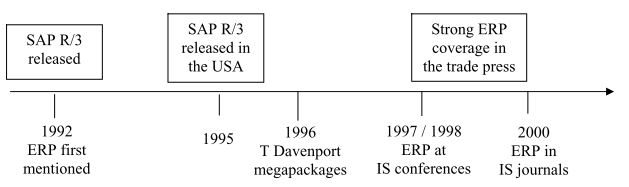
The term ERP began probably for the first time in 1992 (Klaus, Rosemann, & Gable, 2000). Klaus, Helmut, and Gable (2000) indicated that Lopes in his article of 1992 showed how that ERP was conceived of at the time the term was coined and praised ERP systems as “better, faster and more economical business solutions” (p. 27). ERP is described as the new information systems paradigm. Thomas Davenport introduced IS community to ERP systems in 1996. ERP papers were presented at three international information systems conferences in 1997 which marked the beginning of the period of literature. Thomas Davenport avoided the term ERP and called it mega-packages. Figure 1 shows the evolution of ERP.
Figure
1. The Evolution of ERP and The
Introduction of Information System to ERP (Klaus et al., 2000).
The importance of ERP
has increase in the information system
literature over the past few years (Klaus et al., 2000). ERP attracted the
attention of the IS field once it became apparent that large, and mainly US-based
corporations had begun to install these systems. (Nah, Zuckweiler, &
Lee-Shang Lau, 2003) indicated that Holland, Light, and Gison (1999) found that
business and IT legacy systems determine the degree of IT and organizational
change required for ERP implementation success.
Enterprise resource
planning (ERP) system is a packaged
software system that enables organizations to manage the efficiency and effectiveness of resources use such as
materials, human resources, finance and so forth (Klaus et al., 2000; Nah et
al., 2003; Wailgum & Perkins, 2018).
The ERP system supports a
process-oriented view of an enterprise and standardizes business process across
the organization (Nah et al., 2003). These ERP systems
are comprehensive, packaged software solutions to
integrate the complete range of a business’s processes and functions to present
a holistic view of the business from single
information and IT architecture (Klaus et al., 2000). Organizations which implemented ERP systems found it cost
effective and a competitive necessity (Klaus et al., 2000).
ERP Advantages and ERP Standardization
ERP systems provide various benefits to organizations including operational
benefits, managerial benefits, strategic benefits, IT infrastructure benefits,
and organizational benefits (Shang & Seddon, 2000). The operational benefits include cost reduction, cycle
time reduction, productivity improvement, quality improvement, and customer
services improvement. The managerial benefits include better resource
management, better decision making, and better performance control. The
strategic benefits include support current and future business growth plan,
support business alliance, building business innovation, building cost
leadership, generating or enhancing product differentiation, building external
linkages, worldwide expansion, and enabling e-business. The IT infrastructure benefits include
increased business flexibility, IT costs reduction, increased IT infrastructure
capability. The organizational benefits
include supporting business organizational change, facilitating business
learning and broaden employment skills;
empowerment changed the culture
with common visions, changing employees’
behavior with shifted focus, and better employees’ morale and satisfaction (Shang & Seddon, 2000).
The significant
advantages of the enterprise system are
that all modules of the IS can easily communicate with each other, offering
various efficiencies over the stand-alone
system (Pearlson & Saunders,
2001).
Information from one functional area is often
needed by another area in business.
For instance, the inventory system stores information about vendors who
supply specific parts. The same information is
also required by the accounts payable system, which pays the vendors for
their products. It makes sense to integrate these two systems to have a single accurate
record of vendors. ERP systems
are useful tools for organizations seeking to centralize operations and
decision making because this centralization will provide effective use of the
organizational databases (Pearlson & Saunders,
2001). Redundancy of the data entries and duplicate
data will be eliminated; standards for numbering,
naming and coding may be forced; and data and records can be cleaned up through
standardization. The ERP system can
reinforce the use of standard procedures across different locations.
Standardization plays a significant
role in the efficiency of the enterprise (Pearlson & Saunders,
2001). The inconsistency
of the data can cause significant issues
and must be addressed in ERP
systems. For instance, when integrating
two systems such as inventory and payable, the vendor name can be different in
inventory than in payable. Example of
this scenario can be IBM can be listed in the inventory as IBM corp., while in
payable International Business Machines.
This inconsistency of the data makes it challenging
to integrate databases and must be addressed for ERP systems to provide the
optimal advantages. The implementation
of ERP system requires organizations to make changes in the structure of the
organization and often in the individual tasks implemented by workers. Managers
are required to change the business process and more likely to redesign them
completely to accommodate the information system.
ERP System Architecture
Various studies discussed ERP system framework and architecture. (Al-Mudimigh, Ullah, & Saleem, 2009) discussed ERP framework of an automated data mining system. The proposed framework has three primary layers; CRM layer, the ERP layer, and Knowledge Discovery Layer. The CRM layer contains sales management, marketing management, customer service management, and prediction and forecasting. The ERP layer contains purchasing, sales, technology maintenance, production, accounting, audit, and warehouse. The knowledge discovery layer contains selected data, transformed data, rule-based DB, data warehouse, data mining, and results. Figure 2 illustrates the proposed ERP framework.
Figure
2. ERP Proposed Framework (Al-Mudimigh et al., 2009).
(Bahssas, AlBar, & Hoque, 2015) discussed various types of ERP architectures from the client-server framework, web-based ERP, Cloud ERP, N-tier ERP, and mobile ERP architecture. The mobile ERP architecture is selected for this discussion as it is a practical example in the age of the digital world. The mobile ERP architecture is divided into four tiers; the ERP system tier, content access engine and cache storage tier, content extraction engine tier, and user interface tier. The tier of the content access engine and cache storage contains cache structures, CML and remote function call (RFC) server. This tier is responsible for building queries based on mobile users request, and data retrieve in XML format. The RFC server is used to enable the business functions of an ERP system remotely. Tier three is the content extraction engine which takes charge of presentation logic and determines the type of browsers used by user’s mobile devices. Tier four is the user interface tier where mobile devices such as WAP-enabled phones, and PDAs with their particular browser and GUI are integrated (Bahssas et al., 2015). Figure 3 illustrates the selected Mobile ERP framework.
Figure 3. Mobile ERP Architecture (Bahssas et al., 2015).
Conclusion
In the age of Big Data and Big Data Analytics, the
role of information system in ERP has increased than ever before. ERP at the beginning was isolated from IS
until Thomas Davenport introduced IS community to ERP systems in 1996. The integration of ERP with IS is a complex process
and requires commitment from management and long-term vision. Enterprises
should plan for such a shift at the budget level, IT professionals’ levels and
operational level. This process is not
an overnight process, but it requires a holistic view of the business operation
at present as well as for the
future. It requires a comprehension of
the role of the current technology such as BD and BDA in ERP. Organizations are under pressure to be
competitive and stay competitive in the current digital world. ERP provides various benefits to the organization from operational benefits to IT
benefits. Various studies proposed
various ERP frameworks. In summary, ERP systems sit at the center of any
organization’s information technology infrastructure because of the various
benefits of ERP systems empowering businesses.
References
Al-Mudimigh, A. S., Ullah, Z.,
& Saleem, F. (2009). A framework of an automated data mining systems using
ERP model. International journal of
computer and Electrical Engineering, 1(5), 651.
Bahssas, D. M.,
AlBar, A. M., & Hoque, M. R. (2015). Enterprise resource planning (ERP)
systems: design, trends and deployment. The
International Technology Management Review, 5(2), 72-81.
Klaus, H.,
Rosemann, M., & Gable, G. G. (2000). What is ERP? Information Systems Frontiers, 2(2), 141-162.
Nah, F. F.-H.,
Zuckweiler, K. M., & Lee-Shang Lau, J. (2003). ERP implementation: chief
information officers’ perceptions of critical success factors. International journal of Human-computer
Interaction, 16(1), 5-22.
Pearlson, K.,
& Saunders, C. (2001). Managing and Using Information Systems: A Strategic
Approach. 2001: USA: John Wiley & Sons.
Shang, S., &
Seddon, P. B. (2000). A comprehensive framework for classifying the benefits of
ERP systems. AMCIS 2000 proceedings,
39.




 Think and Knowledge Tank