
Dr. O. Aly
Computer Science
The purpose of this discussion is to address two good-quality research papers on customer relationship management (CRM). The chosen articles for this discussion are (Ngai, Xiu, & Chau, 2009; Rygielski, Wang, & Yen, 2002). The reason for selecting these two papers is that they discuss CRM in the context of business intelligence and data mining.
The first journal (Rygielski et al., 2002) is about data mining techniques for CRM. The authors discussed various aspects of the CRM as well as data mining. They also discussed the importance of understanding the customers’ lifecycle and the data mining techniques that can be used to extract value from the customers’ data. Various data mining techniques are discussed and their application with CRM.
The second journal (Ngai et al., 2009) is about the application of data mining techniques in CRM, and a literature review and classification. The authors identified nine hundred articles to the application of data mining techniques to CRM. Seven data mining techniques are identified to include association, classification, clustering, forecasting, regression sequence discovery, and visualization. The authors indicated that classification and association models are the two commonly used models for data mining in CRM. Four CRM dimensions are identified as customer identification, customer attraction, customer retention, and customer development.
Customer Relationship Management (CRM)
(Rygielski et al., 2002) defined CRM using four elements of a simple framework; know, target, sell and service. CRM includes a set of processes and enabling systems to support the enterprise strategy to develop long term, profitable relationships with specified customers (Ngai et al., 2009). The foundation for successful CRM strategy involves the customers’ data and information technology tools. The rapid growth of the internet and the emerging technologies increased the opportunities for marketing and transformed the way relationship between business and customers are managed (Ngai et al., 2009).
Enterprises are required to know and understand its market and customers, which involve detailed customer intelligence to select the most profitable customers and identify those no longer worth targeting (Ngai et al., 2009; Rygielski et al., 2002). The target entails the products to be sold to certain customers through specific channels. The selling element of CRM requires enterprises to campaign management to increase the effectiveness of the marketing department. Enterprises seek to retain their customers through services such as call center and help desk.
CRM Old Model and Relationship Marketing
Technology plays a significant role in marketing. Relationship marketing has become a reality due to the technology application and the advancement in technology (Ngai et al., 2009; Rygielski et al., 2002). Various enterprises and businesses gained competitive advantages due to the application of technologies such as business intelligence, data mining, data warehouse. Data mining technique assists organizations to extract value from the data. When organizations apply data mining techniques, they can determine valuable customers and predict hidden behaviors and allowing businesses to make proactive knowledge-driven decisions. Data mining provides automated and future-oriented analysis which is beyond the past events that are based on historical data (Rygielski et al., 2002).
The old model of ‘design-build-sell’ which is a product-oriented view is being replaced by ‘sell-build-redesign which is a customer-oriented view (Rygielski et al., 2002). The new approach to one-to-one marketing challenged the traditional process of mass-marketing. The marketing goal of the traditional approach is to reach more customers and expand the customer base.
Two-Stage CRM Concepts
Customer Focus: The first stage is to master the basics of building and developing customer focus. This concept shifts the focus from product orientation to customer orientation and define market strategy from outside-in and not from inside-out. The focus should be on the needs of customers and not on the product’s features (Rygielski et al., 2002).
CRM Integration: The second stage goes beyond the basics by integrating CRM across the entire customer experience chain, leveraging technology to achieve real-time customer management, and continuously innovating the value proposition to customers (Rygielski et al., 2002).
CRM Components
Customer Data: CRM involves several components. Enterprises must first process customer information before the process of CRM begins. Customers data can be collected through internal customer data or external sources. Customer internal data sources include summary tables that describe customers via billing records, customer surveys of a subset of customers who answer the detailed question, and behavioral data contained in transaction systems such as weblogs, credit card records and so forth (Rygielski et al., 2002).
Data Warehouse: Data warehouse is a critical component for a successful CRM strategy. Data required for CRM can be limited to a marketing data mart with limited feeds from other corporate systems. External data sources can be a key source for gaining customer knowledge advantage. These external data sources include lookups for current address and phone, household hierarchies, Fair-Isaacs Corp (FICO) credit scores, and webpage viewing profiles (Rygielski et al., 2002).
Analytical Tools: CRM system must analyze the data using statistical tools, OLAP and data mining. Marketing professionals are required to understand the customer data and business imperative whether the enterprise uses the traditional statistical techniques or one of the data mining software tools. Enterprises should employ data mining analysts who will be involved in the analysis and make sure the business does not lose sight of the original reason for implementing the data mining technique. The segmentation of the market is the result, and decisions are made regarding which segments are attractive (Rygielski et al., 2002).
Campaign Execution and Tracking: Enterprises should execute campaigns and track the results. Campaign management software manages and monitors the communications of customers across multiple touchpoints such as direct mail, telemarketing, customer service, point-of-sale, email, and the web. People and processes contribute to facilitating the interaction between marketing, information technology and sales channels (Rygielski et al., 2002).
Data Mining and Knowledge Discovery
Data mining is defined as a sophisticated data search capability using statistical algorithms to discover correlations and patterns in data (Rygielski et al., 2002). The term data mining is an analogy to the gold or coal mining, indicating that data nuggets are buried in the large volume of the corporate data warehouses, or information dropped on a website, most of which can lead to better understanding and use of the data. Data mining approach is complementary to other analysis techniques such as statistics, on-line analytical processing (OLAP), spreadsheets, and necessary data access. In summary, data mining is another approach to find meaning and value in the data that can aid enterprises to make better strategic and tactic decisions (Ngai et al., 2009; Rygielski et al., 2002).
When organizations apply data mining techniques, they can discover patterns and relationships hidden in the data. This process of discovering patterns and relationships is part of a more extensive process known as ‘knowledge discovery” (Rygielski et al., 2002). The process of knowledge discovery describes the required steps to ensure meaningful output. Data mining does not eliminate the need for organizations to understand the data and basic statistical methods. Data mining does not find patterns or relationships that can be trusted blindly without verification. The result must be verified. Data mining assists in generating hypotheses. However, data mining does not validate these hypotheses.
Data Mining Evolution and Building Blocks
Data mining evolved through four significant phases from the 1960s to 1980s, to 1990s, and 2000s (Rygielski et al., 2002). Data mining began with the data collection in the 1960s for simple calculations such as summations and average. The information at this phase answered business questions related to figures derived from data collection sites, such as the total revenue, or average total revenue over a specified period. Specific application programs were created for collecting data and calculations. Data access is the second data mining generation phase in the 1980s, where databases were used to store data in a structured format. Organizations were able to query the database to access certain data for a specific period. In the 1990s, data navigation phase began as a logical step after the data access where organizations could obtain either a global view or drill down to a particular site for comparison with its peers. In the 2000s, data mining phase began with the online analytic tools for real-time feedback and information exchange with collaborating business units.
The primary building blocks of data mining have been developing for decades. These building blocks include statistics, artificial intelligence, and machine learning (Rygielski et al., 2002). These data mining core components are mature. When integrating these building blocks of the data mining with a relational database, they develop a business environment which can capitalize on knowledge previously buries within the systems. Figure 1 shows the core components of data mining.

Figure 1. Core Components of Data
Mining.
Data Mining Core Process
When using data mining, the data is formed and constructed into a model. The model describes patterns and relationships derived from the data. The implementation of data mining involves three general processes. The discovery phase is the process of looking in the database to find hidden patterns without pre-determined hypotheses about the patterns. The predictive phase is the process of taking the discovered pattern and using them for future prediction. The forensic analysis is the process of applying the extracted patterns to find anomalous or unusual data elements (Rygielski et al., 2002). Figure 2 illustrates these three essential processes.
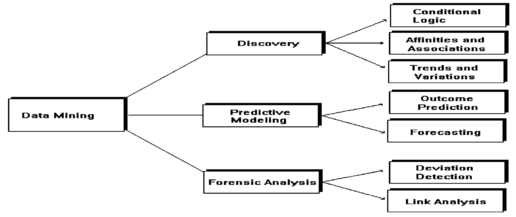
Figure 2. Data Mining Three Core
Processes (Rygielski et al., 2002).
Data Mining Models and Benefits
Data mining has six types of data models to solve various types of business problems; classification, regression, association analysis, sequence discovery, clustering (Ngai et al., 2009; Rygielski et al., 2002), time series (Rygielski et al., 2002), and visualization (Ngai et al., 2009). Classification and regressions are used to make predictions, while association and sequence discovery is used to describe behavior. Clustering model can be used for either forecasting or description. Prediction and descriptive data mining are used for retail, banking, telecommunication, and other applications.
In the retail sector, retailers can keep detailed records of every shopping transactions via store-branded credit cards and point-of-sale systems. Retailers can better understand the various customer segments. Retail applications include performing basket analysis, sales forecasting, database marketing, merchandise planning and allocation (Rygielski et al., 2002). The banking sector can deploy knowledge discovery for various applications such as card marketing, cardholder pricing and profitability, fraud detection, and predictive life-cycle management. The telecommunications sector can utilize knowledge discovery for various applications such as call detail record analysis, and customer loyalty. Other knowledge discovery applications are emerging in a variety of sectors such as customer segmentation, manufacturing, warranties, and frequent flier incentives. For the forensic analysis, banks and financial entities can use it for fraud detection to analyze the abnormalities in the data.
Enterprises can integrate data mining into the decision-making process. However, data mining implementation requires skill sets and technology. While data mining is frequently implemented at the regional or central organization, front line management and operations should have the knowledge gained through the data mining. The communication of this knowledge gained through data mining can be through an algorithm for scoring, a score or a recommended action associated with a particular customer, employee or a transaction (Rygielski et al., 2002).
Data Mining Techniques
Data mining techniques involve the retention-based technique and the distillation-based technique (Rygielski et al., 2002). The retention-based technique applies to tasks of predictive modeling and forensic analysis, and not to the knowledge discovery because they do not distill any patterns. The distillation-based technique has three categories; logical, cross-tabulation, and equational. These three methods extract patterns from a dataset and use the patterns for various purposes. The logical approach handles numeric and non-numeric data, while equations require all data to be numeric, and cross-tabulation work only with non-numeric data. Figure 3 shows the data mining techniques.
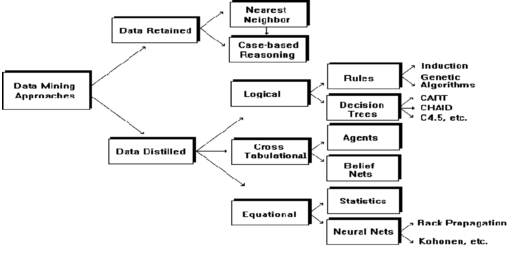
Figure 3. Data Mining Techniques (Rygielski et al., 2002).
Data Mining and CRM
CRM is a broad topic with many layers, one of which is data mining, which is a method or tool that can aid enterprises in their quest to become more customer-oriented. (Rygielski et al., 2002) discussed the customer lifecycle and the data mining that can aid organizations to gain competitive advantages and customer privacy.
Customer’s Lifecycle and Data Mining: CRM lifecycle involves the stages in the relationship between customer and the business. Enterprises can increase the customer’s value by increasing their use or purchase of products they already have, selling them more or higher-margin products, and keeping the customers for a more extended period. The customer relationship changes over time, evolving as the business and customer learn more about each other. The customer lifecycle involves four stages; prospects, responders, active customers former customers. The prospects customers are not yet customers but are in the target market. The responders are prospects who show interest in the product. The active customers are those who are currently using the product or service. The former customer is those who fall into various categories, such as bad customers who did not pay their bills, customers who moved their business to the competing products, customers who incurred a high cost, or customers who are no longer in the target (Rygielski et al., 2002).
Marketing Data Intelligence (MDI): Marketing data intelligence (MDI) is defined as “combining data-driven marketing and technology to increase the knowledge and understanding of customers, products, and transactional data to improve strategic decision making and tactical marketing activity, delivering the CRM challenge” (Rygielski et al., 2002). Enterprises should understand the customers’ lifecycle because it provides a good framework for applying data mining to CRM. The customer’s lifecycle tells what information is available on the input side of the data mining, and what is likely to be interesting on the output side of the data mining. Data mining can be used over some time to predict changes in detail. Enterprises can predict the behavior surrounding a particular lifecycle event such as retirement and find other people in a similar life stage and determine which customers are following similar behavior patterns. The marketing data intelligence is the outcome of this process.
Marketing Data Intelligence (MDI) Components: MDI involves two critical components; customer data transformation, and customer knowledge discovery. The raw data extracted and transformed from a wide range of internal and external databases, marts or warehouses. The collected data gets stored in a centralized location where it can be accessed and explored. The process is continued through customer knowledge discovery, where data mining is implemented, and useful patterns and inferences can be drawn from the data. The process must be measured and tracked to ensure results are pushed to campaign management software. Data mining plays a significant role in the process of CRM (Rygielski et al., 2002). The data mining process involves the interactions with data mart or warehouse in one direction, and the interaction with campaign management software in the other direction. The link between data mining and the campaign management was mostly manual. The trend today is to integrate the data mining and the campaign management to gain a competitive advantage. Enterprises can gain a competitive advantage from such integration by ensuring that the data mining software and the campaign management software share the same definition of the customer segment to avoid modeling the entire database. For instance, if the ideal segment is about high-income males with the age range of 25-35 living in the northeast, the analysis should be limited to this segment.
Data Mining and Customers’ Privacy: The data mining provides various benefits to businesses. However, it can invade the privacy of the customers. (Rygielski et al., 2002) argued that the personalization of CRM is far from the invasion of the privacy. Personal information can be classified into two categories; data provided and accessible to users, and data generated and analyzed by businesses. Before data mining techniques became popular, customer’s data was collected on a self-provided or transactional basis. Customers provide general descriptive data which contain demographic data about themselves. The transactional data refers to data obtained when a transaction takes place, such as product name, quantity, location, and time of purchase. Data mining helps turn customer data into customer profiling information, which belongs to the second category. It includes customer value, targeting information, customer rating, and behavior tracking. When abusing this information, people may also suffer from certain forms of discrimination such as insurance or loss of career. The central issue of privacy is to find a balance between privacy rights for consumers’ protection and businesses benefits.
(Rygielski et al., 2002) argued that privacy is more of a policy issue than a technology issue. One basic principle for Enterprises when using personalized technology is to disclose to their customers the kinds of information they are seeking and how that information will be used. While some list objectives for ethical information and privacy management, others develop a Privacy Bill of Rights that includes fair access by individuals to their personal information. The privacy of customers can be protected when customers do not have to reveal their identities and can remain anonymous even after implementing data mining. Various security measures such as encryption and firewall should be implemented.
Conclusion
The discussion involved two main articles that discussed data mining application and CRM. The application of data mining techniques in CRM is an emerging trend in the industry. The relationship between business and customers are taking a different path in the presence of the Internet, and Big Data Analytics techniques such as data mining. Enterprises are under pressure to gain a competitive advantage using data mining techniques to extract value from customers’ data. Enterprises are also under pressures to ensure the protection of the customer’s private information. Various data mining techniques are available such as statistics and machine learning. Enterprise should apply the appropriate data mining technique to CRM strategy to gain competitive advantages by not only gaining customers but also retaining the customers.
References
Ngai, E. W., Xiu, L., & Chau, D. C. (2009). Application of data mining techniques in customer relationship management: A literature review and classification. Expert Systems with Applications, 36(2), 2592-2602.
Rygielski, C., Wang, J.-C., & Yen, D. C. (2002). Data mining techniques for customer relationship management. Technology in society, 24(4), 483-502.
 Think and Knowledge Tank