
Dr. O. Aly
Computer Science
Abstract
The purpose of this project is to discuss critical information technology solutions used to gain competitive advantages. The discussion begins with Big Data and Big Data Analytics addressing essential topics such as the Hadoop ecosystem, NoSQL databases, Spark integration for real-time data processing, and Big Data Visualization. Cloud computing is an emerging technology to solve Big Data challenges such as storage for the large volume of the data, and the high-speed data processing to extract value from data. Enterprise Resource Planning (ERP) is a system that can aid organizations to gain competitive advantages if implemented right. The project discusses various success factor for the ERP system. Big Data plays a significant role in ERP, which is also discussed in this project. The last technology addressed in this project is the Customer Relationship Management (CRM), its building blocks and integration. The project addresses the challenges and costs associated with CRM. The best practice of CRM is addressed which can assist in the successful implementation of CRM. In summary, enterprises should evaluate various information technology systems that are developed to aid them to gain competitive advantages.
Keywords: Big
Data Analytics; Cloud Computing; ERP; CRM.
Introduction
Enterprises should evaluate various information technologies to gain competitive advantages in the market. Big Data and Big Data Analytics are one of the significant topics in information technology and computer science. Cloud computing is another critical topic in the same domains, as cloud computing emerged to solve the challenge of Big Data. Thus, this project begins with these top information technologies. The discussion covers various major topics in Big Data such as the Hadoop ecosystem, Spark for real-time processing. The discussion of the cloud computing covers the various service models and deployment models which cloud computing offers.
The most common business areas that require information technology support include Enterprise Resource Planning (ERP), Customer Relationship Management (CRM), Product Life Cycle Management (PLM), Supply Chain Management (SCM), and Supplier Relationship Management (SRM) (DuttaRoy, 2016). Thus, this project discusses ERP and CRM as additional critical information technology systems that aid Enterprises gain competitive advantages.
Big Data and Big Data Analytics
Big Data is now the buzzword in the field of computer science and information technology. Big Data attracted the attention of various sectors, researchers, academia, government and even the media (Géczy, 2014; Kaisler, Armour, Espinosa, & Money, 2013). In the 2011 report of the International Data Corporation (IDC), it is reporting that the amount of the information which will be created and replicated will exceed 1.8 zettabytes which are 1.8 trillion gigabytes in 2011. This amount of information is growing by a factor of 9 in just five years (Gantz & Reinsel, 2011).
BD and BDA are terms that have been used interchangeably and described as the next frontier for innovation, competitions, and productivity (Maltby, 2011; Manyika et al., 2011). BD has a multi-V model with unique characteristics, such as volume referring to the large dataset, velocity refers to the speed of the computation as well as data generation, and variety referring to the various data types such as semi-structured and unstructured (Assunção, Calheiros, Bianchi, Netto, & Buyya, 2015; Hu, Wen, Chua, & Li, 2014). BD is described as the next frontier for competition, innovation, and productivity. Various industries have taken this opportunity and applied BD and BDA in their business models (Manyika et al., 2011). There are many technologies such as Cloud Computing, Hadoop Map/Reduce Hive, and others have emerged to deal with the phenomena of the Big Data. Data without analysis has no value to organizations.
Hadoop Ecosystem
While the velocity of BD leads to the speed of generating large volume of data and requires speed in data processing (Hu et al., 2014), the variety of the data requires specific technology capabilities to handle various types of dataset such as structured, semi-structured, and unstructured data (Bansal, Deshpande, Ghare, Dhikale, & Bodkhe, 2014; Hu et al., 2014). Hadoop ecosystem is found to be the most appropriate system that is required to implement BDA (Bansal et al., 2014; Dhotre, Shimpi, Suryawanshi, & Sanghati, 2015). Hadoop technologies have been in the front-runner for Big Data application (Bansal et al., 2014; Chrimes, Zamani, Moa, & Kuo, 2018). Hadoop ecosystem will be part of the implementation requirement as it is proven to serve well with intensive computation using large datasets (Raghupathi & Raghupathi, 2014; Wang, Kung, & Byrd, 2018). The Hadoop version that is required is version 2.x to include YARN for resource management (Karanth, 2014). Hadoop 2.x also include HDFS snapshots to provide a read-only image of the entire or a particular subset of a filesystem to protect against user errors, backup, and disaster recovery (Karanth, 2014). The Hadoop platform can be implemented to gain more insight into various areas (Raghupathi & Raghupathi, 2014; Wang et al., 2018). Hadoop ecosystem involves Hadoop Distributed File System, MapReduce, and NoSQL database such as HBase, and Hive to handle a large volume of dataset using various algorithms and machine learning to extract values from the medical records that are structured, semi-structured, and unstructured (Raghupathi & Raghupathi, 2014; Wang et al., 2018). Other components to support Hadoop ecosystem include Oozie for workflow, Pig for scripting, and Mahout for machine learning which is part of the artificial intelligence (AI) (Ankam, 2016; Karanth, 2014). Hadoop ecosystem includes other tools such as Flume for log collector, Sqoop for data exchange, and Zookeeper for coordination (Ankam, 2016; Karanth, 2014). HCatalog is a required component to manage the metadata in Hadoop (Ankam, 2016; Karanth, 2014). Figure 1 shows the Hadoop ecosystem before integrating Spark for real-time analytics.
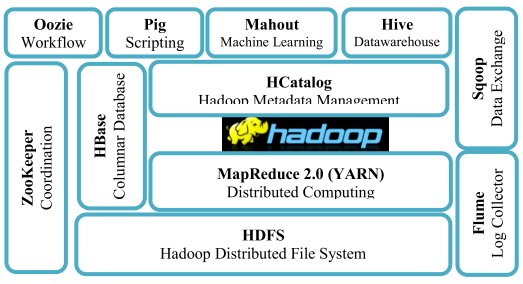
Figure 1. Hadoop Architecture Overview (Alguliyev & Imamverdiyev, 2014).
NoSQL Databases
In the age of BD and BDA, the traditional data store is found inadequate to handle not only the large volume of the dataset but also the various types of the data format such as unstructured and semi-structured (Hu et al., 2014). Thus, Not Only SQL (NoSQL) database is emerged to meet the requirement of the BDA. These NoSQL data stores are used for modern, and scalable databases (Sahafizadeh & Nematbakhsh, 2015). The scalability feature of the NoSQL data stores enables the systems to increase the throughput when the demand increases during the processing of the data (Sahafizadeh & Nematbakhsh, 2015). The platform can incorporate two scalability types to support the large volume of the datasets; the horizontal and vertical scalability. The horizontal scaling allows the distribution of the workload across many servers and nodes to increase the throughput, while the vertical scaling requires more processors, more memories and faster hardware to be installed on a single server (Sahafizadeh & Nematbakhsh, 2015).
NoSQL data stores have various types such as MongoDB, CouchDB, Redis, Voldemort, Cassandra, Big Table, Riak, HBase, Hypertable, ZooKeeper, Vertica, Neo4j, db4o, and DynamoDB. These data stores are categorized into four types: document-oriented, column-oriented or column-family stores, graph database, and key-value (EMC, 2015; Hashem et al., 2015). The document-oriented data store can store and retrieve collections of data and documents using complex data forms in various formats such as XML and JSON as well as PDF and MS word (EMC, 2015; Hashem et al., 2015). MongoDB and CouchDB are examples of document-oriented data stores (EMC, 2015; Hashem et al., 2015). The column-oriented data store can store the content in columns aside from rows with the attributes of the columns stored contiguously (Hashem et al., 2015). This type of datastore can store and render blog entries, tags, and feedback (Hashem et al., 2015). Cassandra, DynamoDB, and HBase are examples of column-oriented data stores (EMC, 2015; Hashem et al., 2015). The key-value can store and scale large volumes of data and contains value and a key to access the value (EMC, 2015; Hashem et al., 2015). The value can be complicated, but this type of data stores can be useful in storing the user’s login ID as the key referencing the value of patients. Redis and Riak are examples of the key-value NoSQL data store (Alexandru, Alexandru, Coardos, & Tudora, 2016). Each of these NoSQL data stores has its limitations and advantages. The graph NoSQL database can store and represent data using graph models with nodes, edges, and properties related to one another through relations which will be useful for unstructured medical data such as images, and lab results. Neo4j is an example of this type of graph NoSQL database (Hashem et al., 2015). Figure 2 summarizes these NoSQL data stores, data types for storage, and examples.
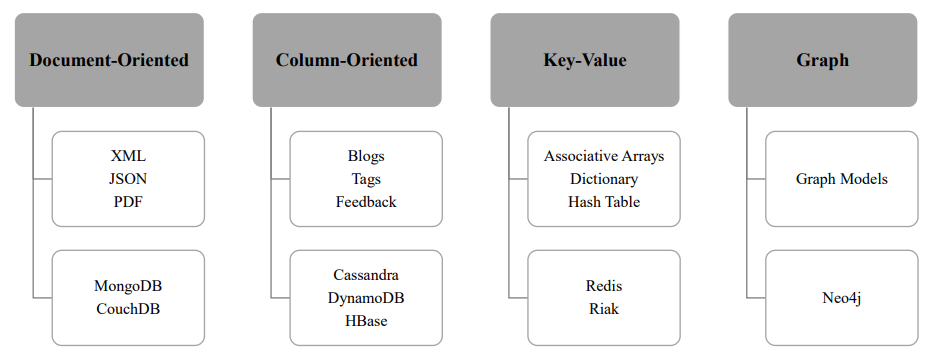
Figure 2. Big Data Analytics NoSQL Data Store Types.
Spark Integration for Real-Time Data Processing
While the architecture of Hadoop ecosystem has been designed in various scenarios for data storage, data management statistical analysis, and statistical association between various data sources distributed computing and batch processing, businesses requires real-time data processing to gain competitive advantages. However, the real-time data processes cannot be met by Hadoop alone (Basu, 2014). Real-time analytics will tremendous value to the healthcare proposed system. Thus, Apache Spark is another component which is required for real-time data processing. Spark allows in-memory processing for fast response time, bypassing MapReduce operations (Basu, 2014). With Spark integration with Hadoop, stream processing, machine learning, interactive analytics, and data integration will be possible (Scott, 2015). Spark will run on top of Hadoop to benefit from YARN and the underlying storage of HDFS, HBase and other Hadoop ecosystem building blocks (Scott, 2015). Figure 3 shows the core engines of the Spark.
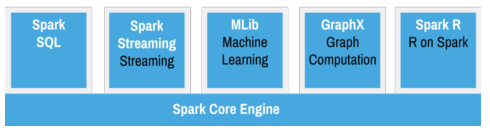
Figure 3. Spark Core Engines (Scott, 2015).
Big Data Visualization
Visualization is one of the most powerful presentations of the data (Jayasingh, Patra, & Mahesh, 2016). It helps in viewing the data in a more meaningful way in the form of graphs, images, pie charts that can be understood easily. It helps in synthesizing a large volume of data set such as healthcare data to get at the core of such raw big data and convey the key points from the data for insight (Meyer, M., 2018). Some of the commercial visualization tools include Tableau, Spotfire, QlikView, and Adobe Illustrator. However, the most commonly used visualization tools in healthcare include Tableau, PowerBI, and QlikView.
Cloud Computing Technology
Numerous studies discussed and addressed the definition of cloud computing, as it was not well defined (Foster, Zhao, Raicu, & Lu, 2008). As an effort to identify precisely the term cloud computing IT practitioners, the academics and research community came up with various definitions. (Vaquero, Rodero-Merino, Caceres, & Lindner, 2008) suggested twenty-two definitions to cloud computing from different research studies. The underlying concepts of cloud computing rely heavily on providing computing power, storage services, software services, and platform services on demand to customers over the internet (Lewis, 2010). The access to cloud computing services can scale up or down as needed, and the consumers use the pay-per-use or pay-as-you-go model (Armbrust et al., 2009; Lewis, 2010).
The National Institute of Standards and Technology (NIST) proposed an official definition of cloud computing. Cloud computing enables ubiquitous, convenient, on-demand network access to a shared pool of configurable computing resources such as network, servers, storage, applications, and services. Organizations can quickly provision and release these resources with minimal effort of management or interaction from a service provider (Mell & Grance, 2011).
Cloud Computing Essential Characteristics
The essential characteristics of cloud computing technology identified by NIST include on-demand self-service, broad network access, resource pooling, rapid elasticity, and measured service (Mell & Grance, 2011). The on-demand self-service feature provides cloud consumers the computing capabilities such as server time and network storage as needed automatically eliminating the need for any human interaction with a service provider. The broad network access feature provides capabilities to cloud consumers over the network and the use of various devices such as mobile phones, and tablets from anywhere enabling the heterogeneous client platforms. The resource pooling feature provides a multi-tenant model that serve multiple consumers sharing the pool of resources. This feature provides location independence, where the consumers do not know the exact location of the provided resources. The consumer may be able to specify the location at a higher level of abstraction such as country, state, or datacenter (Mell & Grance, 2011). The rapid elasticity feature provides capabilities to scale horizontally and vertically to meet the demand. The measured services feature enables the measurement of the consumption of resources such as processing, storage, and bandwidth. The resource utilization can be monitored, controlled, and reported, providing transparency for both the provider and consumer of the utilized services (Mell & Grance, 2011).
Cloud Computing Three Essential Service Models
Cloud computing offers three essential service models as Infrastructure-as-a-Service (IaaS), Platform-as-a-Service (PaaS), and Software-as-a-Service (SaaS) (Mell & Grance, 2011). The IaaS layer provides the capability to the consumers to provision storage, processing, networks, and other fundamental computing resources. Using IaaS, the consumer can deploy and run arbitrary software, which can include operating systems and application. When using IaaS, the users do not manage or control the underlying infrastructure of the cloud. The consumers have control over the storage, the operating systems, and the deployed application and limited control of some networking components such as host firewall. The PaaS allows the cloud computing consumers to deploy applications that are created using programming languages, libraries, services, and tools supported by the providers. Using PaaS, the cloud computing consumers do not manage or control the underlying infrastructure of the cloud including network, servers, operating systems, or storage. The consumers have control over the deployed applications and possibly configuration settings for the application-hosting environment. The SaaS allows cloud computing consumers to use the provider’s applications running on the infrastructure of the cloud. The SaaS service model consumers can access the applications from various client devices through either a thin client interface, such as a web-based email from a web browser, or a program interface. The SaaS consumers do not control or manage the underlying infrastructure of the cloud such as network, operating systems, storage, or even individual application capabilities, with the possible exception of limited user-specific application configuration settings (Mell & Grance, 2011).
Cloud Computing Four Essential Deployment Models
Cloud computing offers four essential deployment models known as public cloud, private cloud, community cloud, and hybrid cloud (Mell & Grance, 2011). The public cloud reflects the infrastructure of the cloud available to the general public. It can be managed, owned and operated by organizations, academic entities, government entities, or a combination of them. This deployment model resides on the premises of the cloud provider. The private cloud is the cloud infrastructure designed exclusively for a single organization. This deployment model can be managed, owned and operated by the organization, or a third party or a combination of both. This model may reside either on-premises or off-premises. The community cloud is the cloud infrastructure designed exclusively for a specific community of consumers from organizations that have such as security requirement, compliance consideration, and policy. One or more of organizations in the community, a third party or some combination of them can manage, own, operate the community cloud. The community cloud can reside on-premises or off-premises. The hybrid cloud is the cloud infrastructure combining two or more cloud infrastructures such as private, public, or community (Mell & Grance, 2011). Figure 4 presents the full representation of cloud computing technology per NIST including the standard service models, deployment models, and essential characteristics.

Figure 4. Overview of Cloud Computing based on NIST’s Definitions.
Cloud Computing Role in Big Data and Big Data Analytics
Cloud computing plays a significant role in BDA (Assunção et al., 2015). The massive computation and storage requirement of BDA brings the critical need for cloud computing emerging technology (Mehmood, Natgunanathan, Xiang, Hua, & Guo, 2016). Cloud computing offers various benefits such as cost reduction, elasticity, pay per use, availability, reliability, and maintainability (Gupta, Gupta, & Mohania, 2012; Kritikos, Kirkham, Kryza, & Massonet, 2017). However, although cloud computing offers various benefits, it has security and privacy issues using the standard deployment models of public cloud, private cloud, hybrid cloud, and community cloud.
Enterprise Resource Planning (ERP)
American Production and Inventory Control Society (2001), as cited in (Madanhire & Mbohwa, 2016) defined ERP as a method for the effective planning and controlling of all resources needed to take, make, ship and account for customer orders in a manufacturing, distribution or service organization. This functions integration can be achieved through a software package solution offered by vendors to support the seamless integration of all information flowing through the enterprise, such as financial, accounting and human resources. ERP is a business management software that is designed to integrate data sources and processes of the entire organization into a combined system (Bahssas, AlBar, & Hoque, 2015).
ERP system is a popular solution which is used by the organization to integrate and automate various processes, performance improvements, and cost reduction. ERP provides business with a real-time view of its core business processes such as production, planning, manufacturing, inventory management and development (Bahssas et al., 2015). The ERP software is a multi-module application that integrates activities across functional departments such as production, planning, purchasing, inventory control, product distribution, and order tracking. It allows the automation and integration of business process by enabling data and information sharing to reach best practices in managing the process of the business.
ERP involves various modules such as accounting, finance, supply chain, human resources, customer information and others (Bahssas et al., 2015; Madanhire & Mbohwa, 2016). ERP production planning module is used to optimize the utilization of manufacturing capacity, parts, components, and material resources. ERP purchases module is used to streamline procurement of required raw materials, as it automates the process of identifying potential suppliers, negotiating prices, placing orders to suppliers and related billing processes. ERP inventory control module is used to facilitate the process of maintaining an appropriate level of stocks in the warehouse through identifying inventory requirements, setting targets, providing replenishment techniques and options, monitoring item usage, reconciling inventory balances and reporting inventory status. ERP sales module is used for order placement, order scheduling, shipping and invoicing. ERP marketing module is used to support lead generation, direct mailing campaign. ERP financial module is used to gather financial data from various departments and generate reports such as balance sheet, general ledger, trial balance. ERP human resources (HR) module is used to maintain a complete employee database to include contact information, salary details, attendance and so forth (Madanhire & Mbohwa, 2016).
Innovations in technology trends have forced ERP designers to establish new development. Thus, new ERP system designs are implemented to satisfy organizations and customers by evolving new ERP business models. Furthermore, one of the biggest challenges for ERP is to keep speed with the manufacturing sector which has been moving rapidly from product-centric to customer-centric focus (Bahssas et al., 2015). Most ERP vendors are required to add a variety of functions and modules to their core systems.
Critical Factors for Successful ERP Implementation
The implementation of ERP systems is costly, and organizations should be careful when implementing it to ensure its success. Some believe that ERP systems could hurt their business because of the potential problems of ERP (Umble, Haft, & Umble, 2003). Various studies identified success factors for ERP. (Umble et al., 2003) addressed the most prominent factors for successful implementation of ERP. The first critical success factor is that organizations should have a clear understanding of the strategic goals. The commitment by top management is another success factor. Successful ERP implementation requires excellent project management. The existing organizational structure and processes found in most enterprises are not compatible with the structure, tools, and types of information provided by ERP systems. Thus, organizational change management is required to ensure the successful implementation of ERP. ERP implementation teams should be composed of highly skilled professionals that are chosen for their skills, past accomplishments, reputation, and flexibility. Data accuracy is another success factor for ERP implementation. The education and training are another success factor for the implementation of the ERP system. (Bahssas et al., 2015) Indicated that reserving 10-15% of the total ERP implementation budget for training will give an organization an 80% chance of successful implementation. Focused performance measures must be included from the beginning of the implementation because if the system is not associated with compensation, it will not be successful.
Big Data and Big Data Analytics Role in ERP
Big Data Analytics plays a significant role in ERP applications (Carlton, 2014; ERP Solutions, 2018; Woodie, 2016). Enterprise data comprises various departments such as HR, finance, CRM and other essential business functions of a business. This data can be leveraged to make ERP functionality better. When Big Data tools are brought together with the ERP system, can unfold valuable insights that can businesses make smarter decisions (Carlton, 2014; Cornell University, 2017; Wailgum, 2018). Many ERP systems fail to make use of real-time inventory and supply chains data because these systems lack the intelligence to make predictions about products demands (Carlton, 2014; ERP Solutions, 2018). Big Data tools can predict demand and help determine what company needs to go forward (ERP Solutions, 2018). Infor co-president Duncan Angove established Dynamic Science Labs (DSL) aiming to use data science techniques to solve a particular class of business problems for its customers. Employees with big data, math, and coding skills were hired in Cambridge, Massachusetts-based organization to develop proof of concept (POC) (Woodie, 2016). Big Data systems such as Apache’s Hadoop are creating node-level operating transparencies which affect nearly every current ERP module in real-time (Carlton, 2014). Managers will be able to quickly leverage ERP Big Data capabilities, thereby enhancing information density and speeding up overall decision-making. In brief, Big Data and Big Data Analytics impact business at all levels, and ERP is no exception.
Customer Relationship Management (CRM)
Customer Relationship Management (CRM) systems assist organizations to manage customer interaction and customer data, automate marketing, sales, and customer support, assess business information and managing partner, vendor, and employee relationships. A quality CRM system can be scalable to serve the needs of small, medium or large business (Financesonline, 2018). CRM systems can be customized to allow business is taking actionable customer insights using back-end analytics, identify opportunities with predictive analytics, personalize customer support, and streamline operations based on the history of the customers’ interaction with the business. Organizations must be aware of the CRM system software available to select the most appropriate CRM system that can better serve their needs.
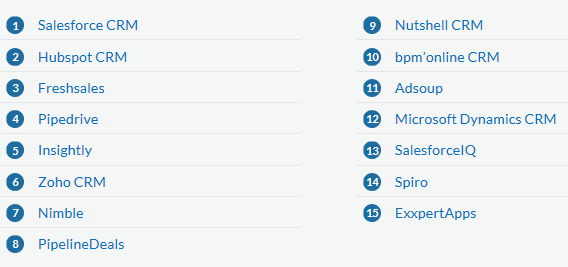
Various reports identified various CRM systems. The best CRM systems include Salesforce CRM, Hubspot CRM, Fresh sales, Pipedrive, Insightly, Zoho CRM, Nimble, PipelineDeals, Nutshell CRM, Microsoft Dynamics CRM, SalesforceIQ, Spiro, and ExxpertApps. Table 1 shows the best CRM systems available in the market.
Table 1. CRM Systems (Financesonline, 2018).
Customer satisfaction is the critical element to the success of the business (Bygstad, 2003; Pearlson & Saunders, 2001). Businesses need to continuously satisfy customers, understand their needs and expectations, provide high-quality products or service at a competitive price to maintain success. These interactions needed to be tracked by the business and analyzed in an organized way to foster long-lasting customer relationships which get transformed into long-term success.
CRM can aid business increase sales efficiency, drive the satisfaction of customers, streamline the process of the business and make it more efficient, and identify and resolve bottlenecks at any of the operational processes from marketing, sales to the product development (Ahearne, Rapp, Mariadoss, & Ganesan, 2012; Bygstad, 2003). The development of customer relationship is not a trivial or straightforward task. When it is done right, it places the business in a competitive edge. However, the implementation of CRM is challenging.
CRM Challenges and Costs
The implementation of CRM demonstrates the value of customers to the business and placing customer service on top priority (Pearlson & Saunders, 2001). CRM plays a significant role in collaborating the effort between customer service, marketing, and sales in an organization. However, the implementation of CRM is challenging especially for small business and startups. Various reports addressed various challenges when implementing CRM. The cost is the most significant challenges organizations are confronted with when implementing the CRM solution (Sage Software, 2015). The development of a clear objective to achieve with the CRM system is another challenge when implementing CRM. Organizations are confronted with the type of deployment whether it should be on-premise or cloud-based CRM. Other challenges involve the employees’ training, the right CRM solution provider and the integration plan in advance (Sage Software, 2015).
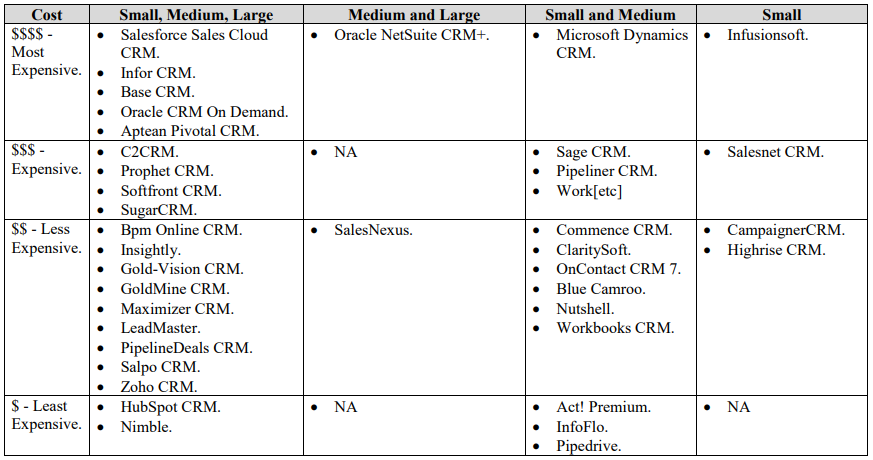
The cost of CRM systems varies from one vendor to another based on the features and deployment key such as data importing, analytics, email integrations, mobile accessibility, email marketing, multi-channel support, SaaS platform, on-premise platform, and SaaS and on-premise. Some vendors offer CRM for small and medium, or small only, while others offer CRM systems for small, medium and large businesses. In a report by (Business-Software, 2019), the cost is categorized for more expensive to least expensive using the dollar sign as $$$$ for most expensive, $$$ for expensive, $$ for less expensive and $ for least expensive. Each vendor CRM system has certain features which must be examined by organizations before making the decision to adopt such a system. Table 2 provides an idea about the cost from the most expensive, expensive, less expensive, to least expensive.
Table 2. CRM System Costs based on the Report by (Business-Software, 2019).
The Building Blocks of CRM Systems and Their Integration
Understanding the buildings blocks of the CRM system can assist in the implementation and integration of CRM systems. CRM involves four core building blocks (Meyer, Matthias & Kolbe, 2005). The acquirement and continuous update of the knowledge base on the needs of customers, motivations, and behavior over the lifetime of the relationship with customers. The application of the customers’ knowledge to continuously improve performance through a process of learning from success and failures is the second building block of CRM system. The integration of marketing, sales, and service activities to achieve a common goal is another building block of the CRM system. The last building block of the CRM system involves the implementation of appropriate systems to support customer knowledge acquisition, sharing, and the measurement of CRM effectiveness.
CRM integration is a critical building block for CRM success (Meyer, Matthias, 2005). The process of integrating CRM involves various organizational and operational functions of the business such as marketing, sales and service activities. CRM requires detailed business processes which can be categorized into three core elements; CRM delivery process, CRM support process, and CRM analysis process. The delivery process involves direct contact with customers to cover part of the customer process such as campaign management, sales management, service management, and complaint management. The support process involves direct contact with the customer that are not designed to fulfill supporting functions within the CRM context such as market research and loyalty management. The analysis process consolidates and analyzes the knowledge of customers collected in other CRM processes. The result of this analysis process is passed to the delivery process, support process and to the service innovation and service production processes to enhance their effectiveness such as customer scoring and lead management, customer profiling and segmentation, feedback and knowledge management.
Best Practices in Implementing These CRM Systems
Various studies and reports addressed best practices in the implementation and integration of CRM systems into the business (Salesforce, 2018; Schiff, 2018). Organizations must choose a CRM that fits their needs. Not every CRM is created equally, and if organizations choose a CRM system without properly researching its features, capabilities, and weaknesses, organizations could end up committed to a system that is not appropriate for the business, and as a result, could lose money. Organizations should decide whether CRM should be cloud-based or on-premise base CRM (Salesforce, 2018; Schiff, 2018; Wailgum, 2008). Organizations should decide whether CRM should be a service contract or one that costs more upfront to install. Business should also decide whether it needs in-depth, highly customizable features, or basic functionality will be sufficient to serve the needs of the business. Organizations should analyze the options and decide on the CRM system that is most appropriate for the business which can serve the needs to build strong customer relationship and gain a competitive edge in the market.
Well-trained personnel and workforce will help organizations achieve its strategic CRM goal. If organizations do not invest in the training of the workforce on how to utilize the CRM system, CRM tools will become useless. The CRM systems become effective as organizations allow them to be. When the workforce is not using the CRM system to its full potentials, or if the workforce is misusing the CRM systems, CRM will not perform its functions properly and will not serve the needs of the business as expected (Salesforce, 2018; Schiff, 2018).
Automation is another critical factor for best practice when implementing CRM systems. Tasks that are associated with data entry can be automated so that CRM systems will be up to date. The automation will increase the efficiency of the CRM systems as well as the business overall (Salesforce, 2018; Schiff, 2018). One of the significant benefits of CRM is its potential in improving and enhancing the cooperative efforts across departments of the business. When the same information is accessible across various departments, CRM systems eliminate confusions that can be caused by using different terms and different information. Data without analysis is not meaningless. Organizations should consider mining the data to get the value that can aid in making sound business decisions. CRM systems are designed to capture and organize massive amounts of data. If organizations do not take advantages of this massive amount of data to turn it into actionable data, the implementation of CRM will be so limited. The best CRM systems are those that come with built-in analytics features which use advanced programming to mine all captured data and use that information to produce valuable conclusions which can be used for future business decisions. When organizations take advantages of the CRM built-in analytical feature and analyze the data that CRM system procures, the valuable information can provide insight for business decisions (Salesforce, 2018). The last element for best practice of the implementation of CRM is for organizations to keep it simple. The best CRM system is the one that will best fit the needs and requirements of the business. The simplicity is a crucial element when implementing CRM. Organizations should implement CRM that is not complex while it is useful and provides everything the business needs. Organizations should also consider making changes to the CRM policies where necessary. The effectiveness of day-to-day operations will be the best indicator of whether the CRM performs as expected, and if it is not, some changes must be made until it performs as expected (Salesforce, 2018; Wailgum, 2008).
Conclusion
This project discussed critical information technology solutions used to gain competitive advantages. The discussion began with Big Data and Big Data Analytics addressing essential topics such as the Hadoop ecosystem, NoSQL databases, Spark integration for real-time data processing, and Big Data Visualization. Cloud computing is an emerging technology to solve Big Data challenges such as storage for the large volume of the data, and the high-speed data processing to extract value from data. Enterprise Resource Planning (ERP) is a system that can aid organizations to gain competitive advantages if implemented right. The project discussed various success factor for the ERP system. Big Data plays a significant role in ERP, which is also discussed in this project. The last technology addressed in this project is the Customer Relationship Management (CRM), its building blocks and integration. The project addressed the challenges and costs associated with CRM. The best practice of CRM is addressed which can assist in the successful implementation of CRM. In summary, enterprises should evaluate various information technology systems that are developed to aid them to gain competitive advantages.
References
Ahearne, M., Rapp, A., Mariadoss, B. J., & Ganesan, S. (2012). Challenges of CRM implementation in business-to-business markets: A contingency perspective. Journal of Personal Selling & Sales Management, 32(1), 117-129.
Alexandru, A., Alexandru, C., Coardos, D., & Tudora, E. (2016). Healthcare, Big Data and Cloud Computing. management, 1, 2.
Alguliyev, R., & Imamverdiyev, Y. (2014). Big data: big promises for information security. Paper presented at the Application of Information and Communication Technologies (AICT), 2014 IEEE 8th International Conference on.
Ankam, V. (2016). Big Data Analytics: Packt Publishing Ltd.
Armbrust, M., Fox, A., Griffith, R., Joseph, A. D., Katz, R. H., Konwinski, A., . . . Stoica, I. (2009). Above The Clouds: A Berkeley View of Cloud Computing. Electrical Engineering and Computer Sciences University of California at Berkeley.
Assunção, M. D., Calheiros, R. N., Bianchi, S., Netto, M. A. S., & Buyya, R. (2015). Big Data Computing and Clouds: Trends and Future Directions. Journal of Parallel and Distributed Computing, 79, 3-15. doi:10.1016/j.jpdc.2014.08.003
Bahssas, D. M., AlBar, A. M., & Hoque, M. R. (2015). Enterprise resource planning (ERP) systems: design, trends and deployment. The International Technology Management Review, 5(2), 72-81.
Bansal, A., Deshpande, A., Ghare, P., Dhikale, S., & Bodkhe, B. (2014). Healthcare data analysis using dynamic slot allocation in Hadoop. International Journal of Recent Technology and Engineering, 3(5), 15-18.
Basu, A. (2014). Real-Time Healthcare Analytics on Apache Hadoop* using Spark* and Shark. Retrieved from https://www.intel.com/content/dam/www/public/us/en/documents/white-papers/big-data-real-time-healthcare-analytics-whitepaper.pdf.
Business-Software. (2019). Top 40 CRM Software Report.
Bygstad, B. (2003). The implementation puzzle of CRM systems in knowledge based organizations. Information Resources Management Journal (IRMJ), 16(4), 33-45.
Carlton, R. (2014). 5 Ways Big Data is Changing ERP Software. Retrieved from https://www.erpfocus.com/five-ways-big-data-is-changing-erp-software-2733.html.
Chrimes, D., Zamani, H., Moa, B., & Kuo, A. (2018). Simulations of Hadoop/MapReduce-Based Platform to Support its Usability of Big Data Analytics in Healthcare.
Cornell University. (2017). Enterprise Information Systems. Retrieved from https://it.cornell.edu/strategic-plan/enterprise-information-systems.
Dhotre, P., Shimpi, S., Suryawanshi, P., & Sanghati, M. (2015). Health Care Analysis Using Hadoop. Internationaljournalofscientific&tech nologyresearch, 4(12), 279r281.
DuttaRoy, S. (2016). SAP Business Analytics: A Best Practices Guide for Implementing Business Analytics Using SAP: Springer.
EMC. (2015). Data Science and Big Data Analytics: Discovering, Analyzing, Visualizing and Presenting Data. (1st ed.): Wiley.
ERP Solutions. (2018). The Role of Big Data Analytics in ERP Applications. Retrieved from https://erpsolutions.oodles.io/big-data-analytics-in-erp/.
Financesonline. (2018). 15 Best CRM Systems for Your Business. Retrieved from https://financesonline.com/15-best-crm-software-systems-business/.
Foster, I., Zhao, Y., Raicu, I., & Lu, S. (2008). Cloud Computing and Grid Computing 360-Degree Compared. Paper presented at the 2008 Grid Computing Environments Workshop.
Gantz, J., & Reinsel, D. (2011). Extracting Value From Chaos. International Data Corporation, 1142, 1-12.
Géczy, P. (2014). Big data characteristics. The Macrotheme Review, 3(6), 94-104.
Gupta, R., Gupta, H., & Mohania, M. (2012). Cloud Computing and Big Data Analytics: What is New From Databases Perspective? Paper presented at the International Conference on Big Data Analytics, Springer-Verlag Berlin Heidelberg.
Hashem, I. A. T., Yaqoob, I., Anuar, N. B., Mokhtar, S., Gani, A., & Khan, S. U. (2015). The Rise of “Big Data” on Cloud Computing: Review and Open Research Issues. Information Systems, 47, 98-115. doi:10.1016/j.is.2014.07.006
Hu, H., Wen, Y., Chua, T., & Li, X. (2014). Toward Scalable Systems for Big Data Analytics: A Technology Tutorial. Practical Innovation, Open Solution, 2, 652-687. doi:10.1109/ACCESS.2014.2332453
Jayasingh, B. B., Patra, M. R., & Mahesh, D. B. (2016, 14-17 Dec. 2016). Security issues and challenges of big data analytics and visualization. Paper presented at the 2016 2nd International Conference on Contemporary Computing and Informatics (IC3I).
Kaisler, S., Armour, F., Espinosa, J. A., & Money, W. (2013). Big Data: Issues and Challenges Moving Forward. Paper presented at the Hawaii International Conference on System Sciences
Karanth, S. (2014). Mastering Hadoop: Packt Publishing Ltd.
Kritikos, K., Kirkham, T., Kryza, B., & Massonet, P. (2017). Towards a Security-Enhanced PaaS Platform for Multi-Cloud Applications. Future Generation computer systems, 67, 206-226. doi:10.1016/j.future.2016.10.008
Lewis, G. (2010). Basics About Cloud Computing. Software Engineering Institute Carnegie Mellon University, Pittsburgh.
Madanhire, I., & Mbohwa, C. (2016). Enterprise resource planning (ERP) in improving operational efficiency: Case study. Procedia Cirp, 40, 225-229.
Maltby, D. (2011). Big Data Analytics. Paper presented at the Annual Meeting of the Association for Information Science and Technology.
Manyika, J., Chui, M., Brown, B., Bughin, J., Dobbs, R., Roxburgh, C., & Byers, A. H. (2011). Big Data: The Next Frontier for Innovation, Competition, and Productivity. McKinsey Global Institute.
Mehmood, A., Natgunanathan, I., Xiang, Y., Hua, G., & Guo, S. (2016). Protection of Big Data Privacy. Institute of Electrical and Electronic Engineers, 4, 1821-1834. doi:10.1109/ACCESS.2016.2558446
Mell, P., & Grance, T. (2011). The NIST Definition of Cloud Computing. National Institute of Standards and Technology (NIST), 800-145, 1-7.
Meyer, M. (2005). Multidisciplinarity of CRM Integration and its Implications. Paper presented at the System Sciences, 2005. HICSS’05. Proceedings of the 38th Annual Hawaii International Conference on.
Meyer, M. (2018). The Rise of Healthcare Data Visualization.
Meyer, M., & Kolbe, L. M. (2005). Integration of customer relationship management: status quo and implications for research and practice. Journal of strategic marketing, 13(3), 175-198.
Pearlson, K., & Saunders, C. (2001). Managing and Using Information Systems: A Strategic Approach. 2001: USA: John Wiley & Sons.
Raghupathi, W., & Raghupathi, V. (2014). Big data analytics in healthcare: promise and potential. Health Information Science and Systems, 2(1), 1.
Sage Software. (2015). Top Challenges in CRM Implementation.
Sahafizadeh, E., & Nematbakhsh, M. A. (2015). A Survey on Security Issues in Big Data and NoSQL. Int’l J. Advances in Computer Science, 4(4), 2322-5157.
Salesforce. (2018). 7 CRM Best Practices to Get the Most out of your CRM. Retrieved from https://www.salesforce.com/crm/best-practices/.
Schiff, J. L. (2018). 8 CRM implementation best practices.
Scott, J. A. (2015). Getting Started with Spark: MapR Technologies, Inc.
Umble, E. J., Haft, R. R., & Umble, M. M. (2003). Enterprise resource planning: Implementation procedures and critical success factors. European Journal of Operational Research, 146(2), 241-257.
Vaquero, L. M., Rodero-Merino, L., Caceres, J., & Lindner, M. (2008). A Break in the Clouds: Towards a Cloud Definition. Association for Computing Machinery: Computer Communication Review, 39(1), 50-55.
Wailgum, T. (2008). Five Best Practices for Implementing SaaS CRM. Retrieved from https://www.cio.com/article/2435928/customer-relationship-management/five-best-practices-for-implementing-saas-crm.html.
Wailgum, T. (2018). What is CRM? Software for Managing Customer Data. Retrieved from https://www.cio.com/article/2439505/customer-relationship-management/customer-relationship-management-crm-definition-and-solutions.html.
Wang, Y., Kung, L. A., & Byrd, T. A. (2018). Big Data Analytics: Understanding its Capabilities and Potential Benefits for Healthcare Organizations. Technological Forecasting and Social Change, 126, 3-13. doi:10.1016/j.techfore.2015.12.019
Woodie, A. (2016). Making ERP Better with Big Data. Retrieved from https://www.datanami.com/2016/07/08/making-erp-better-big-data/.
 Think and Knowledge Tank